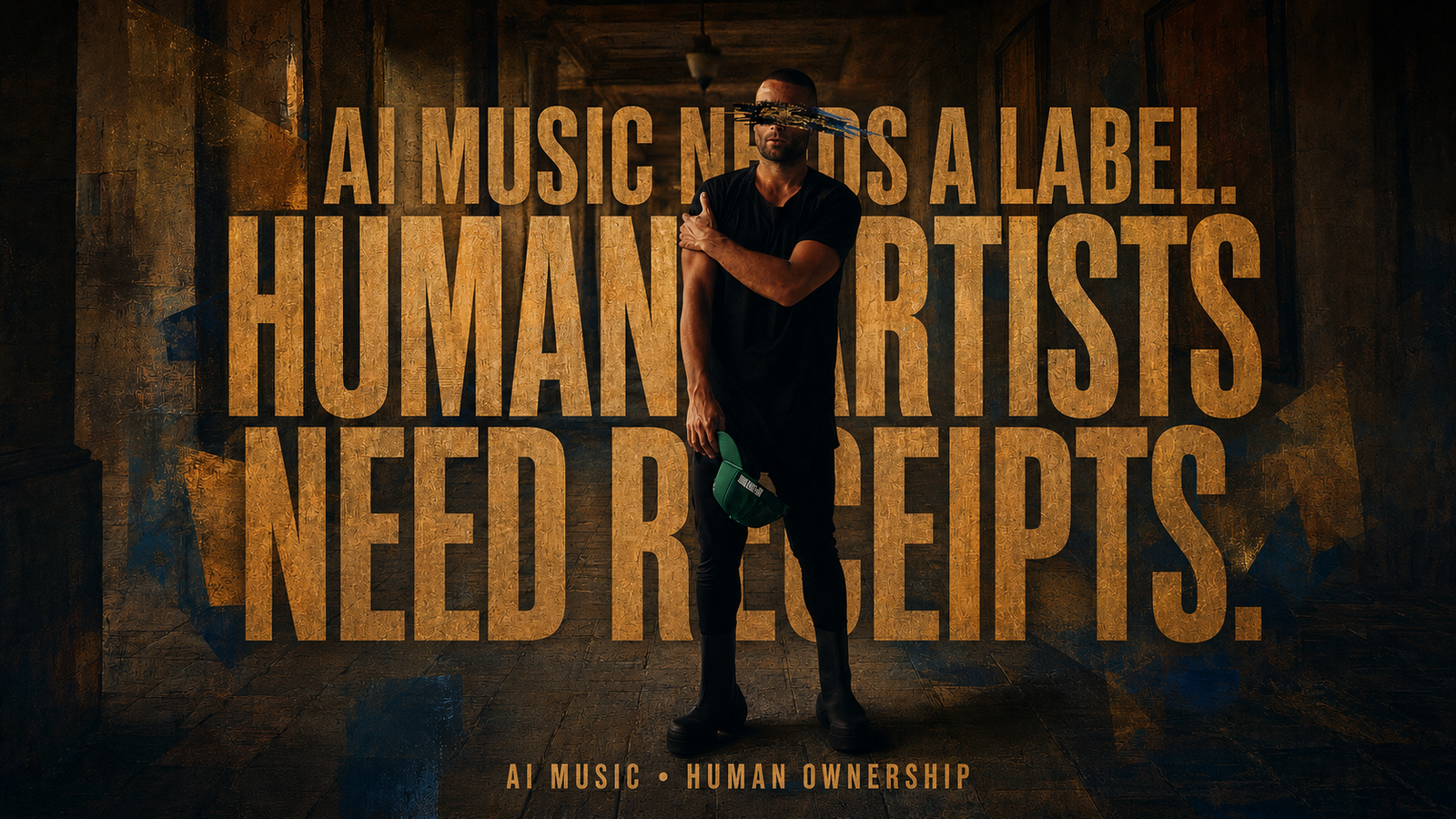
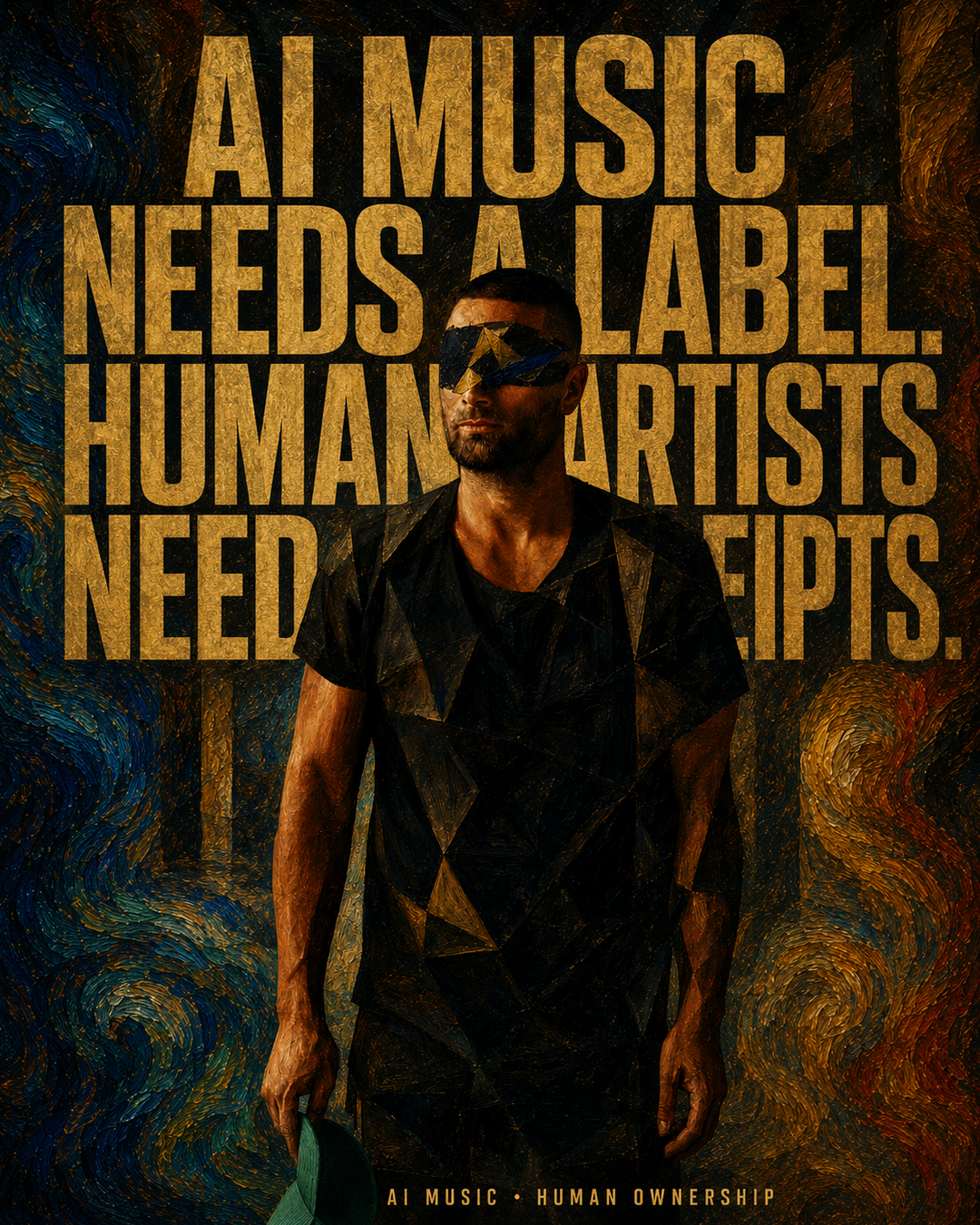
The headline
On July 10, 2026, organizations representing artists, labels, performers and the wider recording business announced a voluntary global approach to two track-level labels: AI-Generated and AI-Assisted. The stated goal is simple: give listeners clearer information about how generative AI was used in a recording.
That is useful. It is also the minimum. A label can tell us that a machine entered the room. It cannot tell us who opened the door, whose work trained the system, who approved the result, or where the money goes.
The uncomfortable opinion
AI is not the enemy. Unaccountable scale is. When a platform can be flooded with limitless inventory, a human artist is no longer competing only with other songs. They are competing with a factory that never sleeps, never tours, never misses a note and never has to explain its sources.
Here is the controversial part: an artist with a documented creative trail should be easier to discover than an anonymous music persona with unlimited output and an advertising budget. History should count. Live performance should count. Credits, consent and a body of work should count.
Today’s archive: ownership before the panic
Today’s LIZZIFY archive pick goes back to a 2024 conversation with Francesco, creator of the Munity NFT platform. The NFT hype cycle changed, but the central problem did not: how does a creator prove ownership, preserve context and carry value forward when platforms keep changing underneath them?
That question matters even more now. Paul Lizzi’s archive is not content debris. It is a chain of receipts: drums, vocals, tours, experiments, podcasts, Web3, AR clothing, AI visuals and the awkward in-between moments that prove a real person kept moving. The archive is the identity layer.
What LIZZIFY is becoming
LIZZIFY does not need to pretend technology is evil. The whole project has always tested new formats. The stronger position is more demanding: use the machine, show the human, name the process and protect the source. The meaningful divide is not technology versus tradition. It is authored work versus anonymous extraction.
Platforms should surface provenance, credits, consent and real-world creative history alongside every AI disclosure. Fans should be able to ask three fast questions: Who made this? Who approved it? Who gets paid? If the answers disappear, innovation is just extraction with a cleaner interface.
Five albums. One journey. Still human.
The current signal is Z11VFY, the fifth chapter after MultiVerse, Vici, First$$$ and Oscura. WEN LAMBO, IGNORESmE and JOMO do not erase the earlier eras; they absorb them. That is the point of the morph from Paul Lizzi into LIZZIFY: new technology, new identity, same accountable creative line.
Tomorrow, another headline meets another tape from the vault. The argument will change. The receipts will still be here.